
Parenting classes by state · Ohio
Court-Ordered Parenting Classes in Ohio
In Ohio, the court-ordered parenting / parent-education requirement is the Parenting seminar / parent-education class (commonly titled a "Seminar for Separating Parents" or "co-parenting/divorce class"), required by each county's Domestic Relations Court under Ohio Revised Code 3109.053 — there is no single statewide curriculum or program name., overseen by Ohio county Courts of Common Pleas, Domestic Relations Divisions (authorized to require the class by local rule under Ohio Revised Code 3109.053; the trial courts are overseen by the Supreme Court of Ohio). Here's who has to take it, whether you can do it online, how long it takes, and how to find a course your county's Domestic Relations Court (the Domestic Relations Division of the Court of Common Pleas) will accept.

Quick answer: parenting classes in Ohio
Online classes accepted. Ohio has no statewide parenting-class mandate and no single statewide approved-provider list; instead most county Domestic Relations Courts require the class by local rule under ORC 3109.053, and each court sets its own approved course, curriculum, and length. Court-approved online courses are widely accepted and are the norm in many counties (e.g., Butler County's 4-hour live-Zoom class, Cuyahoga County's online "Children In Between," and Franklin County's self-paced online "Putting the Children First"). your county's Domestic Relations Court (the Domestic Relations Division of the Court of Common Pleas) decides what counts — confirm the course and format before you enroll or pay.
At a glance
| Is a parenting class required? | Often — required by many counties/courts (not uniformly statewide) |
|---|---|
| Who takes it & when | Parents with minor children in a divorce, dissolution, legal separation, annulment, or custody (allocation of parental rights) case in a county whose Domestic Relations Court requires it — completed before the court allocates parental rights, typically before the final hearing. |
| Typical length | Varies by county (commonly about 2–4 hours) |
| In person or online? | Online classes accepted |
| Program name | Parenting seminar / parent-education class (commonly titled a "Seminar for Separating Parents" or "co-parenting/divorce class"), required by each county's Domestic Relations Court under Ohio Revised Code 3109.053 — there is no single statewide curriculum or program name. |
Ohio-specific rules to know
- Not a statewide statutory mandate: ORC 3109.053 says a court 'may require, by rule or otherwise' parenting classes/counseling, so the requirement comes from each county's local domestic-relations rule — but most counties require it when minor children are involved (e.g., Butler Local Rule DR 5, Cuyahoga Rule 34, Franklin Local Rule 26).
- Both parents typically must complete the class separately, and many courts bar spouses from attending the same session together (e.g., Butler County).
- Deadlines are set by local rule — for example, register within 15 days of filing (Butler County), and the completion certificate must be filed / the class finished before the final hearing (Cuyahoga County requires filing it about two weeks before the final hearing).
- Parents pay the course fee, which the court allocates between them; if the court finds BOTH parents indigent, ORC 3109.053 requires that the cost be waived.
- The course name, approved provider, and length differ by county (Cuyahoga = 'Children In Between' via the Center for Divorce Education; Butler = 'Helping Families Succeed During Divorce'; Franklin = 'Putting the Children First').
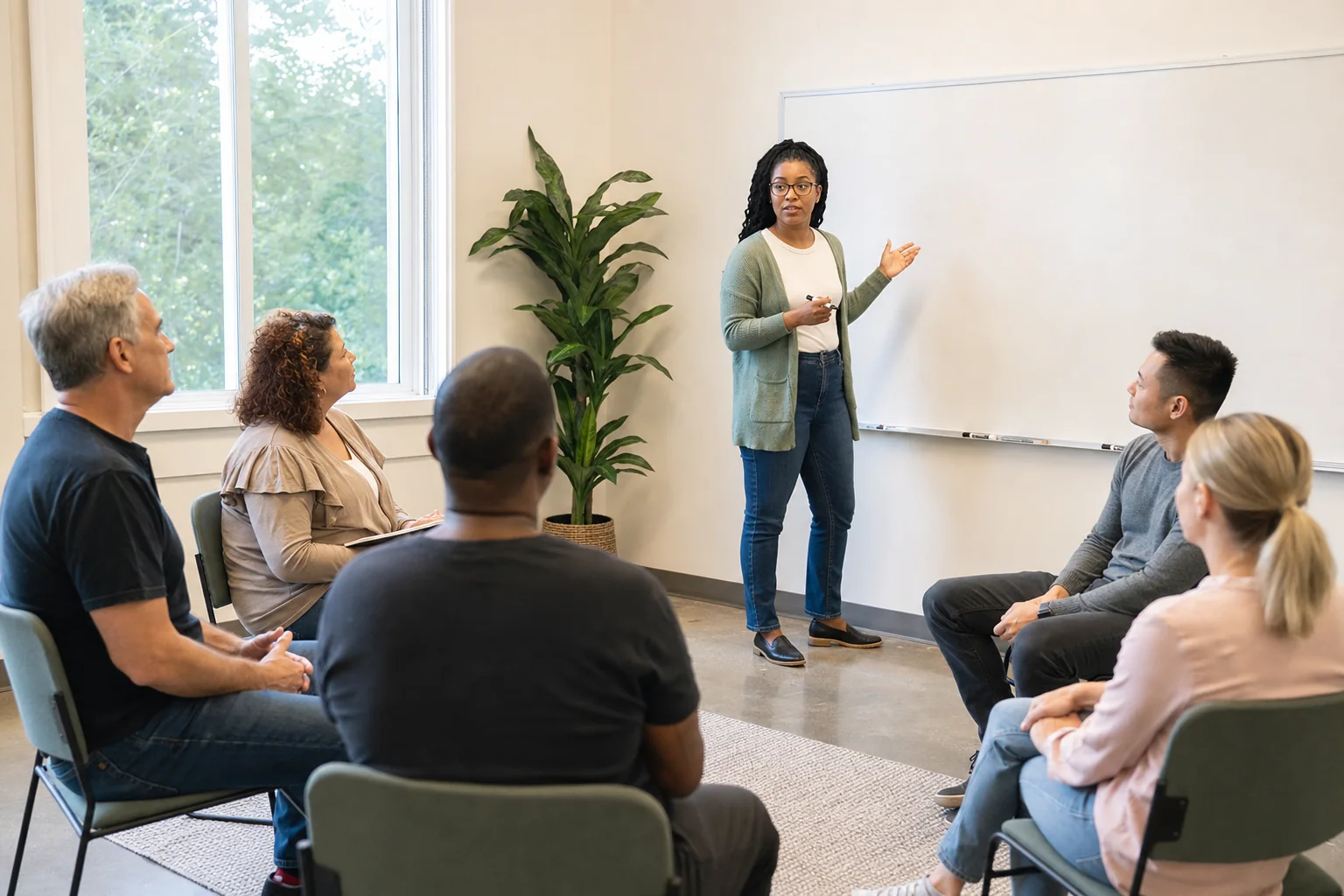
County requirements
Because Ohio sets its parenting-class requirement court by court, the biggest counties run their own named program with their own approved provider and deadline. Here's what the court requires in these Ohio counties — always confirm the current rule with the specific court handling your case.
Cuyahoga County (Cleveland)
Children In Between (parenting-education seminar) — Center for Divorce Education — the court's only approved provider (online; also offered in Spanish). Under Local Rule 34, every parent of a minor child who is divorcing or legally separating in Cuyahoga County must complete a court-approved parenting seminar before the judge allocates parental rights. The court accepts only the online 'Children In Between' course from the Center for Divorce Education, and each parent must finish separately and file the completion certificate with the Clerk of Courts about two weeks before the final hearing. Always confirm the current requirement and deadline with the Cuyahoga County Domestic Relations Court before you enroll or pay.
Full Cuyahoga County guide: rule, deadlines & how to file →
Cuyahoga County Domestic Relations Court — Parenting Education → · Sources: domestic.cuyahogacounty.gov/parenting-services/parenting-education, codes.ohio.gov/ohio-revised-code/section-3109.053
Franklin County (Columbus)
Putting the Children First — court-approved parent-education seminar, offered as a self-paced online course. The Franklin County Domestic Relations Court requires both parents in a divorce, dissolution, or legal separation involving minor children to complete a parent-education seminar, commonly 'Putting the Children First,' available as a roughly two-hour self-paced online course. The court generally will not sign the final decree until each parent files a certificate of completion, and completion is typically due within about 45 days of filing or service. Always confirm the currently approved course and deadline with the Franklin County Domestic Relations Court before you enroll or pay.
Franklin County Domestic Relations & Juvenile Court → · Sources: drj.fccourts.org/Court-Services/Domestic-Court, codes.ohio.gov/ohio-revised-code/section-3109.053
Find an approved parenting class in Ohio
Start with the official state or court list — that's the one your county's Domestic Relations Court (the Domestic Relations Division of the Court of Common Pleas) is most likely to accept — then confirm the specific course with your court or clerk:
Prefer to look on a map? Search Google Maps for parenting classes in Ohio — then check any provider against the official guidance above and your court's order before enrolling.
Can you take it online? Ohio generally accepts approved online parenting courses. An approved online course can be the fastest way to finish — but confirm your county's Domestic Relations Court (the Domestic Relations Division of the Court of Common Pleas) accepts your specific course first. How court-approved online parenting classes work →
Source & accuracy: compiled from Ohio county Courts of Common Pleas, Domestic Relations Divisions (authorized to require the class by local rule under Ohio Revised Code 3109.053; the trial courts are overseen by the Supreme Court of Ohio) and official Ohio court sources. Requirements change and vary by county and case — always confirm the course, format, hours, and deadline with your court before enrolling. Sources: codes.ohio.gov/ohio-revised-code/section-3109.053, supremecourt.ohio.gov/courts/judicial-system/ohio-trial-courts, drcourt.bcohio.gov/parent_education.php, domestic.cuyahogacounty.gov/parenting-services/parenting-education, richlandcountyoh.gov/departments/domesticrelations/Divorce/SuccessfulParenting.